
Is AI the Tipping Point?
Another day, we can discuss the ramifications of AI’s consciousness, but that’s already in the daily news. So we’ll take a ride into the past…
There was a time when life was simple (or was it?): hunting and gathering, building shelter and tools out of available materials, staving off predators or bands of humans. We could say there was relatively little energy expended per person, and humans were in relative ecological balance...until they weren’t. A population increase may lead to some critical resource depletion. In order to survive, either the community has to pack up and move to a resource rich area, or develop a new way to extract an untapped resource: a new technology is born.
Throughout human history, technologies have been invented, and have been necessary, to curb social collapse. There is a view of technology and economics that supposes a newly invented technology is merely a replacement for one that was unsustainable, for instance when too many prehistoric animals were trapped for furs, thereby reducing the animal population, another mode of clothing was necessary, so learning to weave plants into clothing became a replacement. Technology, became a necessary condition to overcome an ecological imbalance. Furthermore, it can be shown that the replacement (new) technology requires additional effort (resources, energy, etc) to maintain, beginning the cycle of increased energy expended per person each time a new technology is created.
The idea that technology creates a more efficient economy is false. It may make our individual lives easier, but it displaces that human energy spent on individual housework to large centralized facilities that create products and useful energy forms.
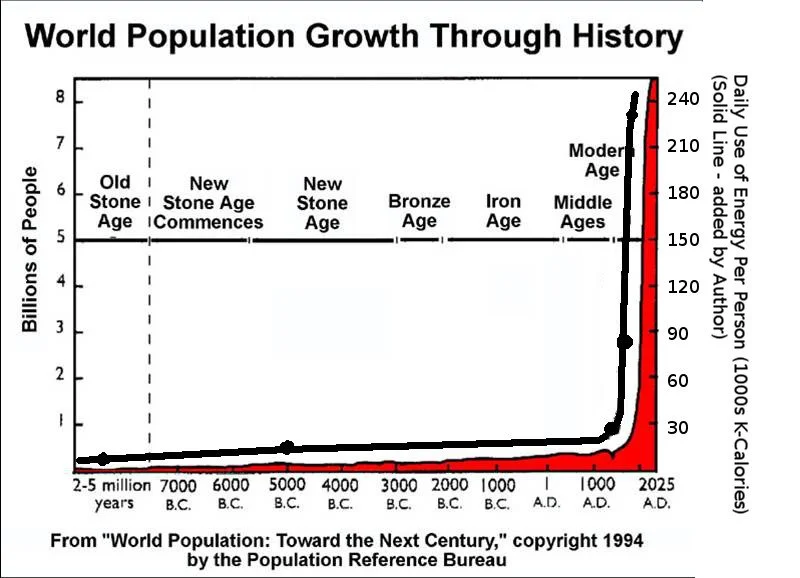
Consequently, not only are these new technologies a requirement to keep a population afloat, but the resources and energy expended increases exponentially. This can be seen by comparing humans per capita energy use over time. Per capita energy use increased very modestly up to the industrial revolution when huge increases appear. This makes sense: each human used very little energy while hunting and gathering, fashioning simple tools. Now, we each have a myriad of manufactured products and appliances at our disposal living in large homes built with materials from around the globe, staring at a soon to be outdated smart phone with the embodied energy of a small car.
I am no great fan of so called factory farming, but realize without it, we would not be able to feed so many people due to its intense use of the land. This type of farming is known to decimate ecosystems and pollute our natural resources.
Looking at a line graph of per capita energy use from the 1800s to the present with a line approaching vertical, it is clear that this is not a trend that can continue indefinitely. We may not know when or how it levels off or turns downward, but it must eventually as there is no infinite amount of energy and resources available to us.
It seems clear that the notion that technology will solve our problems has always been a fallacy. In fact, it is technology which has exasterbated the existing problems, but to its credit, has kept us afloat.
So our current paradox is this: AI, as the new technology of the day, by definition, is a requirement to keep our society from collapse, though with it’s enormous appetite for energy consumption, edges us much closer to that inevitable ecological collapse.
The choice to slow down or stop the development of AI, which I think is the correct choice, means that there will be economic down turn and suffering in order to drastically reduce our energy use.